How to get the right level of safety stock
Just as you might leave for the office early to allow for bad traffic on the day of an important meeting, it’s a good idea for wine, beer and spirits’ importers to order early to secure stock levels before key dates like Christmas. Planning ahead helps you to sail through any supply chain issues that may arise during busy times of the year.
Similarly, looking ahead to the next season and planning for seasonal demand spikes helps you to tackle uncertainty and position stock exactly where and when you need it. For example, what will the weather be like in spring when the Rosé promotion is planned? If the sun shines and the temperature rises, demand could soar. Ordering stock ahead of time is a common strategy that importers use to combat uncertainty.
Uncertainties in supply, uncertainties in demand, or both, are the everyday reality for beverage importers. Importers can deal with these uncertainties by building in some reserves. This might be allowing extra travel time, or by building reserves of stock. Extra stock that provides a buffer if you are not sure how much we might sell is also known as safety stock.
Safety stock helps you to manage uncertainties in the supply chain
Safety stock is extra stock that you bring in to deal with uncertainties in demand, as well as uncertainties in supply. If there were no uncertainties, and you knew the exact demand and supply for your wine, beer or spirits, you would not need safety stock.
There is a correlation between the level of uncertainty and the amount of safety stock needed.
For example, if the average weekly demand is 100, but the variance around this demand can fluctuate between 90 and 110, we would need less safety stock then the same average demand of 100, fluctuating between 10 and 190.
What time frame do we have to consider?
When evaluating the uncertainties in the supply chain, the timeframe that should be considered will depend on the response time of a replenishment decision. If we order today, it will take time for the stock to arrive. The order-to-delivery time frame is called lead time and within the lead time we cannot influence the safety stock anymore. We should have done that earlier.
Therefore when we plan our safety stock, we need to consider the uncertainties in demand and supply during lead time.
The graph below shows a timeline of the stock level in a warehouse. It shows that stock gradually depletes as the product is sold. The steepness of the line represents the level of demand depleting the stock.
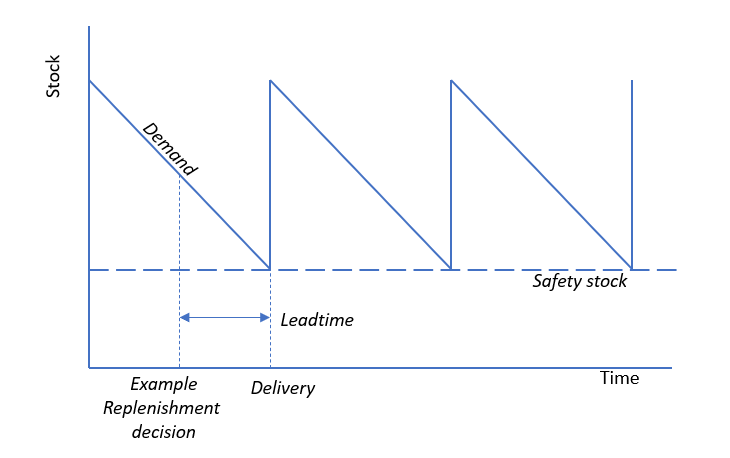
When stock declines to a set threshold, it needs to be replenished. The replenishment order is delivered some time later and the stock increases again. The time between the replenishment decision and the delivery of the stock is the lead time.
When you make a decision to replenish the stock, you may assume that demand will continue at the same level, but what if demand increases and stock levels fall faster? In the second example below, safety stock is used to absorb uncertainty in demand.
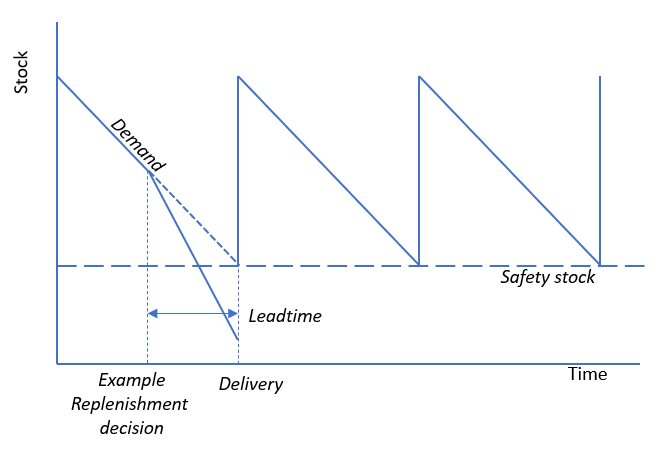
Safety stock can also help to absorb uncertainties in supply. For example, if an order is delayed the safety stock will have to cover demand during the delay, as shown below:


What elements influence the safety stock levels?
As seen in the graphs above, the level of uncertainty in demand and supply (lead time) influences the amount of safety stock required. The duration of the lead time also has an impact. For supply chains with a long lead time, we will need more safety stock to cover the uncertainty in demand.
Another important element to consider is the required availability level. Availability comes at a cost. If you want to be able to cover 99% of demand, you will need more safety stock then if you are happy with 95% availability. Maintaining higher levels of safety stock inventory will naturally increase your costs. However, being ‘out-of-stock’ also comes at a cost. The optimal level of safety stock is therefore the result of balancing the cost of stock with the costs of out-of-stock, and is often the result of a strategic management decision. The required availability level can be different for each product and are often set according to their ABC classification.
How can Hillebrand Gori help to control your safety stock?
As specialist logistic service providers for the beer, wine and spirits industry, we are in an excellent position to support you with your safety stock management. Our support is focused on minimizing the uncertainties in the supply chain. We do this by:
- Providing reliable supply of goods through in-time/in-full deliveries. Through our enhanced global network of warehouses and transport options, we are able to provide a reliable transport service with the option of keeping stock ready in the export country to decouple the production process from the order fulfilment process.
- Understanding that uncertainties in demand are not the same for all parties in the supply chain. A retailer will have a better view of the future demand than a wine producer. A wine producer will have a better view on raw material sourcing and production windows. Therefore, it makes a lot of sense to share information between the various parties in the supply chain. Hillebrand Gori’s Supply Chain Management solution provides the platform to exchange information.
- Providing Supply Chain Management solutions that include a demand forecasting module. This allows our customers to predict future demand based on historical sales, seasonality and promotional demand.
- Offering enhanced safety stock strategies as part of our Supply Chain Management solutions. This includes an algorithm to automatically measure the uncertainties in the supply chain and convert them into required safety stock.

Reviewed by Hillebrand Gori
Safety stock is the extra amount of beverages that a wine, beer or spirits’ importer holds in their inventory to prevent the item going out of stock if demand or supply dynamics change.
Holding safety stock is essential for mitigating risks in supply chain management, particularly for products like alcoholic beverages. It helps importers handle demand fluctuations, supply chain disruptions and lead time variability, reducing the risk of stockouts and improving customer satisfaction. Safety stock also serves as a buffer against forecasting inaccuracies, ensuring consistent operations and reliable service. By maintaining safety stock, businesses can better navigate uncertainties and build trust with their customers.
How can we help your business grow?